For workforce programs
A skill your participants keep, and a number that shows it.
Your organization already provides career counseling, job-search assistance and placement support. Standing Proof is not a replacement for any of it. It is the layer underneath: participants learn to engineer a résumé for any role from a record of what they have actually done, they keep doing it after the cohort ends, and you leave with a measurement of whether it stuck.
Built for local workforce development boards, county workforce programs and the nonprofit providers who deliver for them.
Twenty minutes, not a product demo. If a pilot would not answer anything you need answered, we will say so.

Workshop
A four-hour taught session delivered live by the person who wrote the method, in person or remote, splittable across shorter sittings.
Method and workbook
Every participant works by hand: reading a real posting, decomposing it, recovering their own evidence, and building statements they can defend.
Platform and measurement
Accounts for the cohort, and a 30-day report on activation and continued use. Aggregate figures in one standard report, never participant records. If your funder requires its own template, we fill it in with the same counts at scoping.
Why this transfers when a résumé workshop does not
The usual workshop teaches formatting and phrasing, which is the last ten percent of the work. Participants leave able to reproduce one document and not much else, because the actual difficulty was never addressed: most people cannot presently describe what they did in terms an employer can evaluate.
This method starts there instead. Participants learn to read a posting as a set of requirements, recover evidence from their own history, and state it with the scale and outcome attached. Those are transferable analytical skills, and they keep working on the next posting, and the one after that, without the instructor in the room.
The other reason it persists: participants leave with a free account holding the evidence they captured during the session. The next time they need a résumé, they are not starting from a blank page and a fading memory.
This is also how government itself hires
Many participants are headed for public-sector work, and the federal front door already demands what this method teaches. USAJOBS hands every applicant a one-sentence formula (“Accomplished [X] as measured by [Y], by doing [Z]”) and warns that “the hiring agency will not make assumptions about what’s in your resume.” A participant who has practiced recovering outcomes from their own history is prepared for exactly that sentence.
It fits how your own system is measured, too. The Workforce Innovation and Opportunity Act built accountability and performance reporting into workforce development, and a cohort whose participants leave with documented, measurable accomplishments produces outcomes you can report in those terms, not attendance figures.
The Standing Proof Workforce Pilot
Thirty participants, thirty days. One cohort, run end to end, designed to produce the numbers you would need before committing to anything larger.
- A four-hour workshopTaught live, in person or remote, and splittable across shorter sessions if that suits your cadence.
- Participant workbooksOne per participant, printed: the six-session Participant Workbook, each session pairing an exercise done by hand with the screen in the product where it happens.
- Standing Proof accountsFull access for the cohort window, granted by a single class code entered at signup. No cards, no per-seat purchasing.
- The complete method, publishedYour staff can read the whole thing free and unabridged, with no signup. Learning the method is not gated; training your staff to run it is its own offering, below.
- A cohort report on requestSeats claimed and evidence built so far, sent as a PDF whenever you ask during the thirty days.
- A 30-day reportHow many claimed a seat, how many can now build a targeted résumé from their own record, how many were still doing it at day 30. Participation and demonstrated skill, counted; not placement or wages, which it cannot see.
- An executive debriefA working session on what the numbers showed and what would change at a larger scale.
The pilot is paid, and priced deliberately: large enough that it is delivered properly, small enough that many programs can approve it at the director level. Whether yours can, and what your procurement rules require, is settled on the briefing call. We quote it there rather than publishing a number, because scope varies with cohort size and how much of the delivery your own staff want to own.
Programs that run well from there move to multi-cohort and multi-site arrangements. That conversation happens after a pilot has produced numbers, not before.
Can our own staff run this afterward?
Learning the method is free: it is published in full, unabridged, with no signup, and your staff are welcome to teach from it in their own sessions, credited or not.
Beyond that, three things, and they are not the same thing. Practitioner training is scoped with you on the briefing call: up to fifteen of your staff, the practitioner curriculum and platform access, so they can run the method with their own participants. A train-the-trainer program with an annual curriculum license is scoped per organization on the briefing call. And facilitator certification, which is what lets your staff run certified Standing Proof cohorts with the participant materials and the reporting that goes to your funder, is in development and not yet offered; we would rather say so than imply your staff can be handed it in a pilot.
What you can report afterward
Publicly funded programs answer for their spending, and attendance sheets are weak evidence that anything happened. A cohort here produces figures drawn from what participants actually did, not from a satisfaction survey:
- How many of the seats offered were actually claimed.
- How many participants reached a working evidence base, meaning they documented enough real experiences to build from.
- How many were still adding to their record weeks after the session ended, which is the honest measure of whether a habit took hold.
Those are aggregate counts. Individual career histories belong to the participants who wrote them and are not handed to the program sponsoring the class. When this reaches your security or compliance reviewer, the security overview and accessibility statement were written for them, and a standard DPA is available on request.
Suitable for
County and city workforce departments, one-stop career centers, community colleges and university career services, nonprofit employment programs, union training funds, reentry and veteran transition programs, and employer-side outplacement.
The method assumes no particular industry and no particular seniority. It has been written to work for someone returning to work after a decade out and for a director rebuilding an executive résumé, because both face the same underlying problem.
The method is published
We do not keep it back. The whole method is in the whitepaper, and participants can keep a free account with room for 30 documented experiences. What a pilot buys is delivery: the workshop run for your cohort, the workbooks in their hands, and a report you can put in front of a funder.
Read the method before you commit
The method as worksheets, in full and free. Everything a participant works through, so you can judge the fit against your own reporting.
The Evidence Starter Kit
The worksheet version of the method, for someone with no account.
Open the PDF (11 pages) →Free to print, copy and use, including in your own classes, with or without the software.
The Participant Workbook
The six-session program itself, printed, one per participant. Part of every program we run rather than a download: you see the full workbook on the fit call, and your cohort writes in theirs.
© Enterprise Professional Systems LLC. Provided for use in Standing Proof programs.
What a participant walks out with
Not a résumé they will rewrite next year, but an evidence record they keep on a free account that does not expire when the program ends.
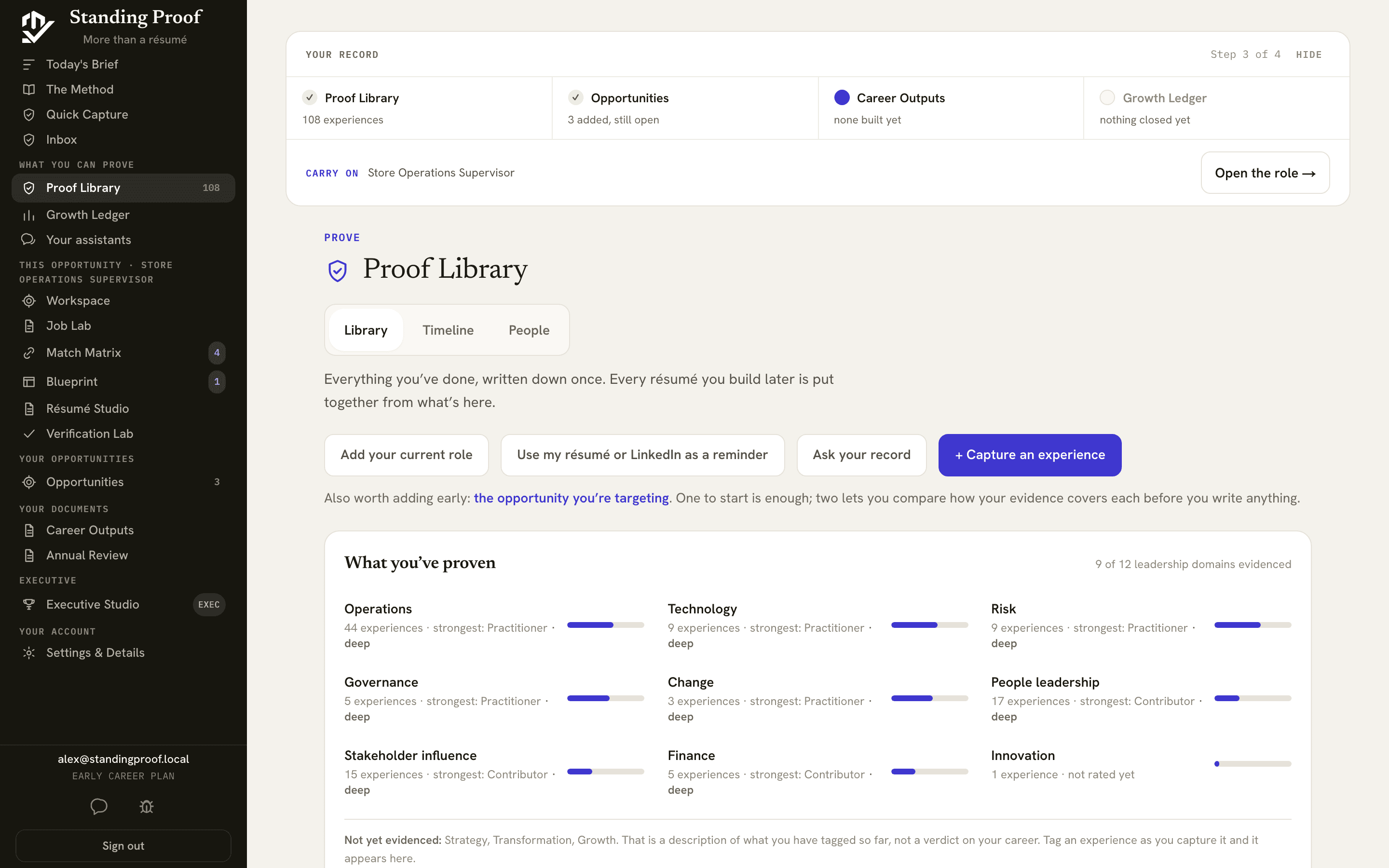
On Early Career
These are the product itself, running on an example account. The names, numbers and history in them are invented; none of it is a real person’s record.
What a program can buy
Quoted for your group, and lower per person as the group grows. Each of these is priced in the conversation: the scope depends on how many people, over what period, and what you already report and to whom. That is why there is no figure beside them, not because it is a secret; ask and you will get a straight answer.
Four-hour workshop, up to 20 participants
A single cohort, one session.
What is included ↓
Four-hour workshop, up to 20 participants
How it’s done
- Four-hour facilitated workshop
- Participant workbooks
Workshop plus participant licenses
A cohort that keeps working after the session.
What is included ↓
Workshop plus participant licenses
How it’s done
- Everything in the four-hour workshop
- Participant platform access
- Aggregate cohort reporting
Career Evidence Lab, 10 participants
Small, high-touch cohorts.
What is included ↓
Career Evidence Lab, 10 participants
How it’s done
- Multi-session facilitated lab
- Per-participant evidence development
- Platform access for the cohort
- Cohort reporting: participation and demonstrated skill
Career Evidence Lab, 20 participants
Full cohorts.
What is included ↓
Career Evidence Lab, 20 participants
How it’s done
- Multi-session facilitated lab
- Per-participant evidence development
- Platform access for the cohort
- Cohort reporting: participation and demonstrated skill
Workforce practitioner training, up to 15 staff
Training an organization's own career staff.
What is included ↓
Workforce practitioner training, up to 15 staff
How it’s done
- Practitioner curriculum
- Staff platform access
Employer skills-first hiring workshop
Employers rather than job seekers.
What is included ↓
Employer skills-first hiring workshop
How it’s done
- Facilitated employer workshop
Scoped together rather than from a list: train-the-trainer and annual curriculum license; custom workforce cohort or program; professional résumé package, per participant.
Start with the twenty-minute conversation. It is where the number is appropriate, and where we will say if none of these is the right instrument for what you are trying to reach.
Book a 20-minute Standing Proof Readiness briefing
Not a product demo. Twenty minutes on where your participants currently lose their evidence, what your funder reporting can and cannot show today, and whether a thirty-participant pilot would answer anything you actually need answered.
Book the briefingPrefer email? hello@standingproof.com
Tell us the program, roughly how many participants, and the timeframe you are working toward. A real person answers.
Want to evaluate the method first? The full whitepaper is public and free, and the method is summarized in about five minutes of reading.