Career & Business Management
Built before you need it
Turn the work you have already done into proof of what you can do next.
Write down what you accomplish once, while you still remember the details. Standing Proof turns it into a résumé, a promotion case or an interview answer aimed at the role in front of you, instead of rebuilding your history every time you apply.
Every experience on your résumé traces back to something you wrote down: what you did, how big it was, what changed, and how you know.
No résumé? Three things you did at work is enough.

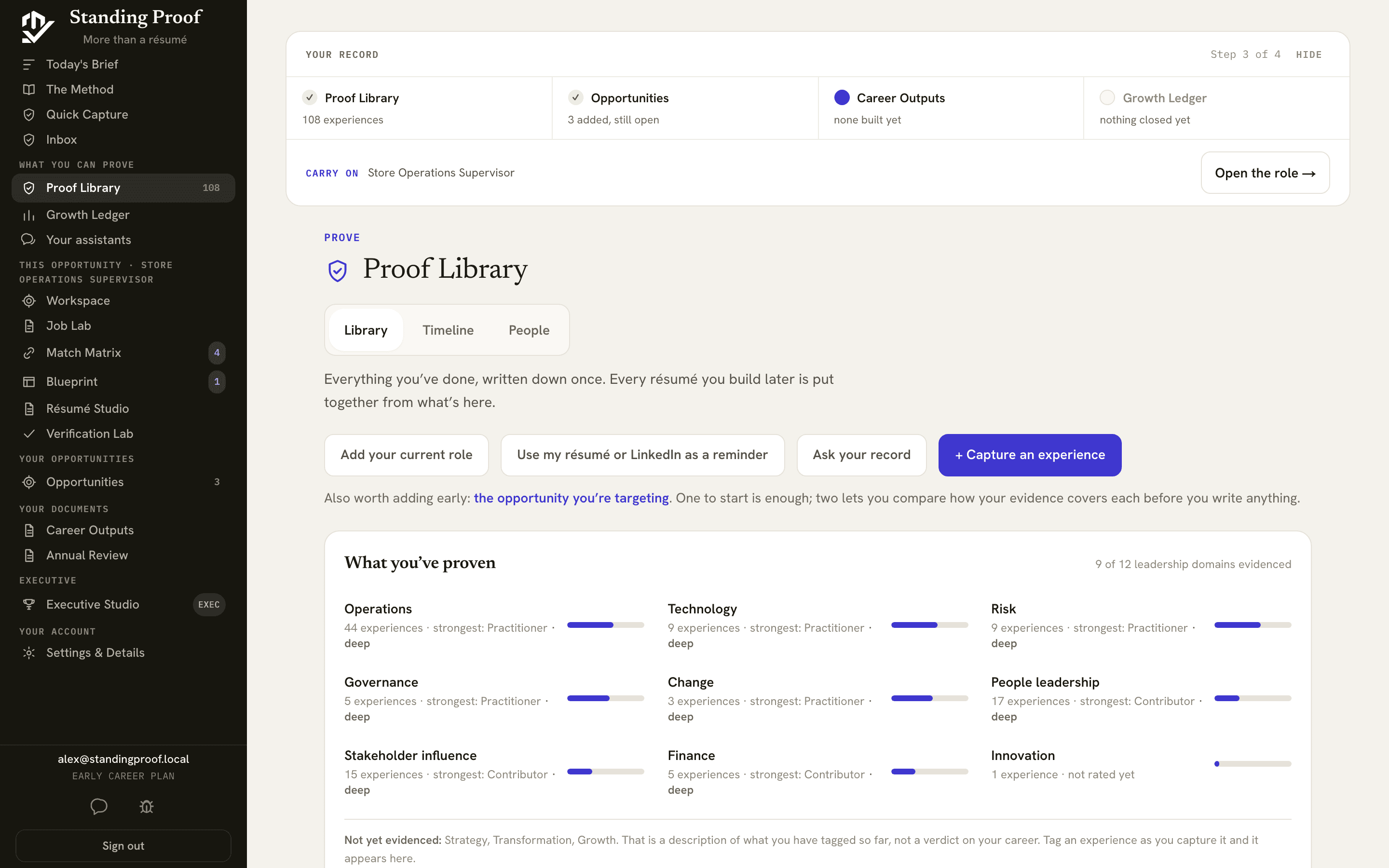
The Proof Library, which every plan includes, shown on Early Career. These are the product itself, running on an example account. The names, numbers and history in them are invented, and none of it is a real person’s record.
Which is you right now?
Two ways in. Both end in the same record.
Be purposeful about it early, or laser-focused when you are in a crunch. The method is the same; what changes is the order you do it in, and how fast.
Laser-focused
Something is happening now
There is a date. The job is to recover the most, fastest, and work one posting properly rather than fifteen lightly.

If it already happened
After a layoff
Rebuilding a career record under time pressure is a different job than maintaining one. This is the order that recovers the most, fastest.
Read how →
If you are searching now
Actively searching
A posting is a requirements document. Once you treat it as one, the question stops being what sounds impressive and becomes what answers this, provably.
Read how →
If you are applying for a federal position
Applying to a federal job
Federal hiring runs on a structure most résumés don't provide: a situation, an action, a measured result, and someone who can confirm it happened.
Read how →Purposeful early
Nothing is wrong yet
Which is exactly when the evidence is cheapest to keep. Five minutes while it is still true, instead of days reconstructing it later.

If nothing is wrong yet
Before you need it
Career evidence compounds. Captured while it is still true, it costs five minutes; reconstructed years later, it costs days, or it is simply gone.
Read how →
If you are just starting
Early career
Everything a twenty-year veteran struggles to reconstruct is currently sitting within your reach. That is a real advantage with an expiry date.
Read how →
If you are staying and rising
Going for promotion
A promotion case argues you are already operating a level up. That evidence is the most fragile kind, and almost nobody captures it.
Read how →
Everyone’s résumé is becoming the same résumé.
Nearly half of hiring managers say they automatically dismiss a résumé they identify as AI-generated, and two thirds say the flood of AI-assisted applications has made it harder to tell what a candidate can actually do. Same phrasing, same structure, and numbers that are all suspiciously exact. A document that could have been anyone’s gets read as no one’s.
Sources: Resume.io, resume rejection survey, 3,000 US hiring managers, January 2025; Robert Half, survey conducted by an independent research firm, more than 2,000 US hiring managers, November 2025.
The only way out is to stop starting from a blank page or a template, and start from your own evidence: what you did, how big it was, what changed, and how you know. That is engineering your career evidence. It is the one thing a generator cannot fake, because none of it ever happened to the generator.
Why a résumé is a lossy format →How this differs from a résumé builder →

Yes, it is work
Five minutes of it, whenever something worth remembering happens.
That is the trade: a little effort while it is still fresh, instead of a lot of guessing later. No dashboard to check daily, no streak to keep. Just a place that is already there the next time you need it.
The method
Six stages, borrowed from how software actually gets built
Requirements, traceability, verification: applied to proving what you’ve done instead of guessing at what sounds good.
01
Read
Understand what a posting is actually asking, before you touch a résumé.
02
Map
Decompose the requirements. See what's weighted, what's a gate, what's assumed.
03
Prove
Connect your documented evidence to each requirement, or find the honest gap.
04
Write
Compile a résumé from evidence you already stated. Nothing invented.
05
Verify
Check every experience line traces to something you recorded before it leaves your hands.
06
Grow
Every posting teaches you something. The library compounds. It never resets.
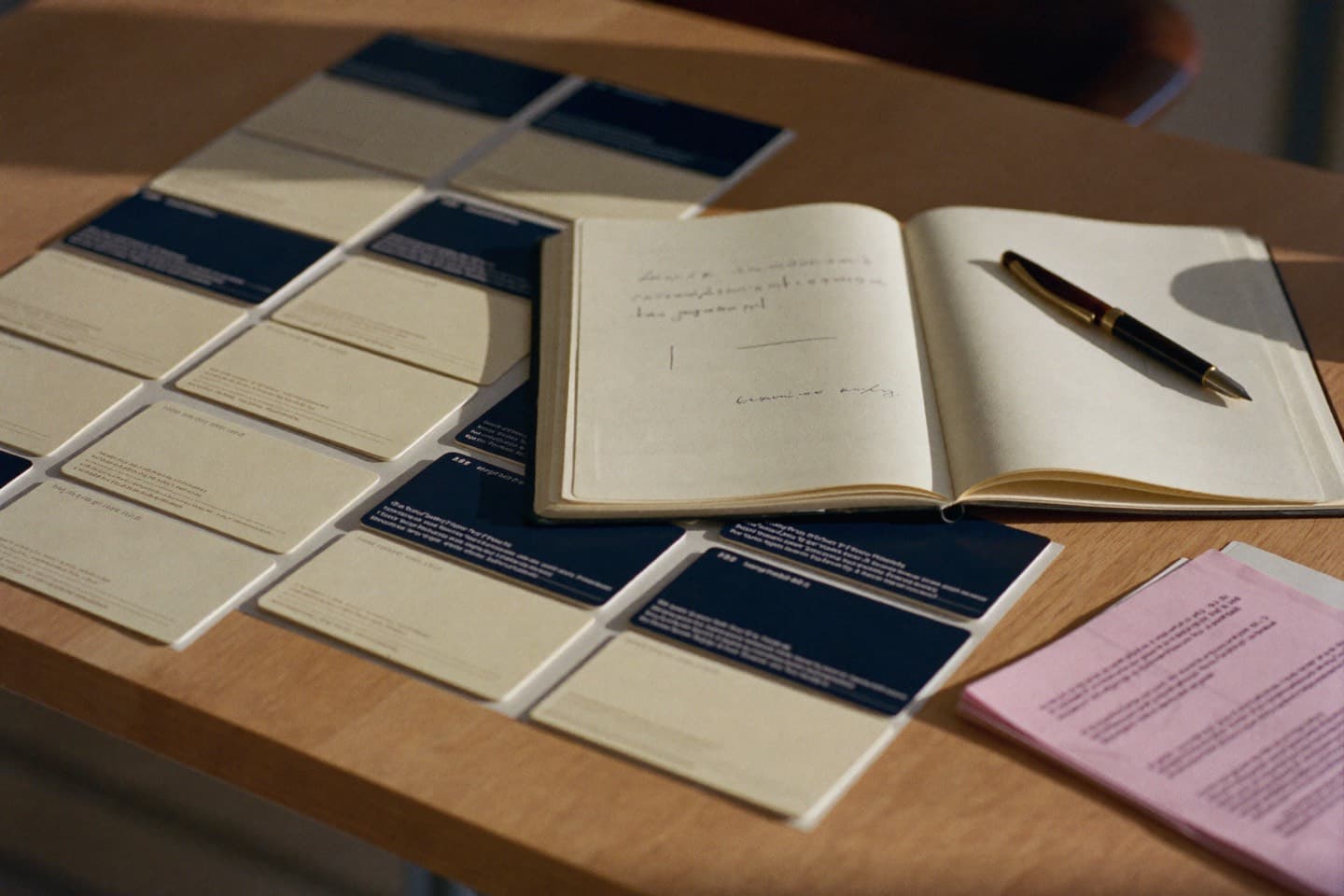
It works on paper before it works on a screen
Every stage of this was designed to run with a printed posting, a highlighter, and index cards on a table. The software makes the habit easier to keep; it was never what made the method work.
What “proof” means here
Traceability is not verification, and this product does not confuse them. When the Verification Lab says a résumé holds up, it means every experience line traces to something you recorded and the document is consistent with itself: dates that agree, no line said twice. It does not mean anyone checked your history with a third party.
- Stated
- An experience in your own words: what you did, how big it was, what changed, how you know.
- Every experience line on your résumé links back to one, and an AI draft is written only from the ones you choose. That is traceability.
- Supported
- Something outside your memory that backs the record: a review, a letter, a dashboard, a certificate.
- Attached to the record where your plan allows files (Professional and Executive), or named in the record's answer to "What could substantiate this?" on any plan. Either counts on the resolution ladder's top rung, Evidenced. Never sent to AI.
- Corroborated
- Someone else confirms it: a reference, a former manager, a client.
- That is a call an employer makes, and nothing here replaces it. Standing Proof makes the call easy to survive, because everything on the page is something you can talk about for ten minutes.
One application, end to end
Watch somebody actually do it.
Five screens from the running product, in the order the work happens, on the cheapest paid plan. Same posting, same person, same five experiences the whole way down.
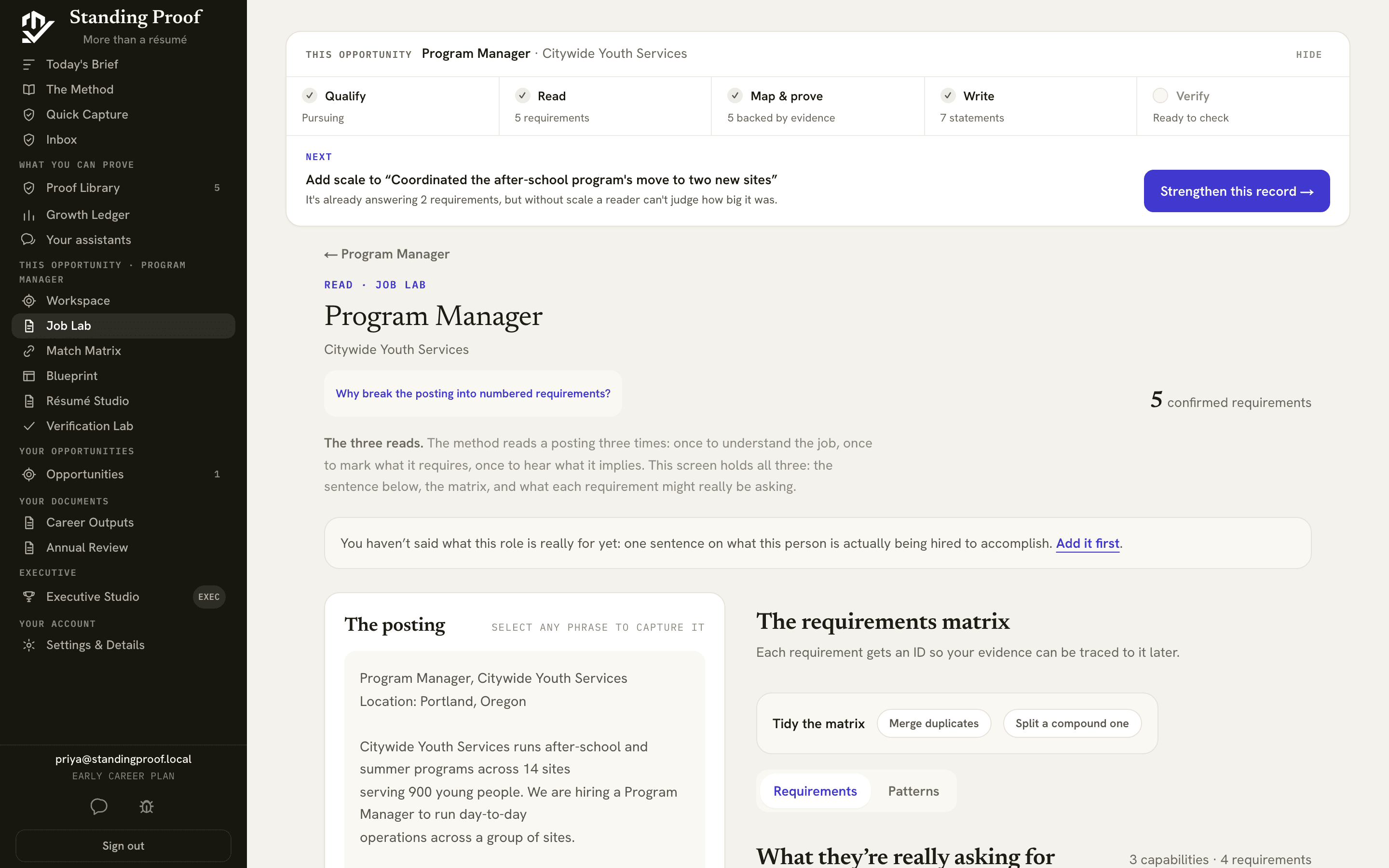
The posting arrives
Read it as a requirements document, not an advert.
Priya is a program coordinator going for a Program Manager job at a youth services nonprofit. Before she writes a word, the posting comes apart into five numbered requirements, each one a thing she will have to prove, in plain language instead of the employer’s.
On Early Career What can she actually prove?
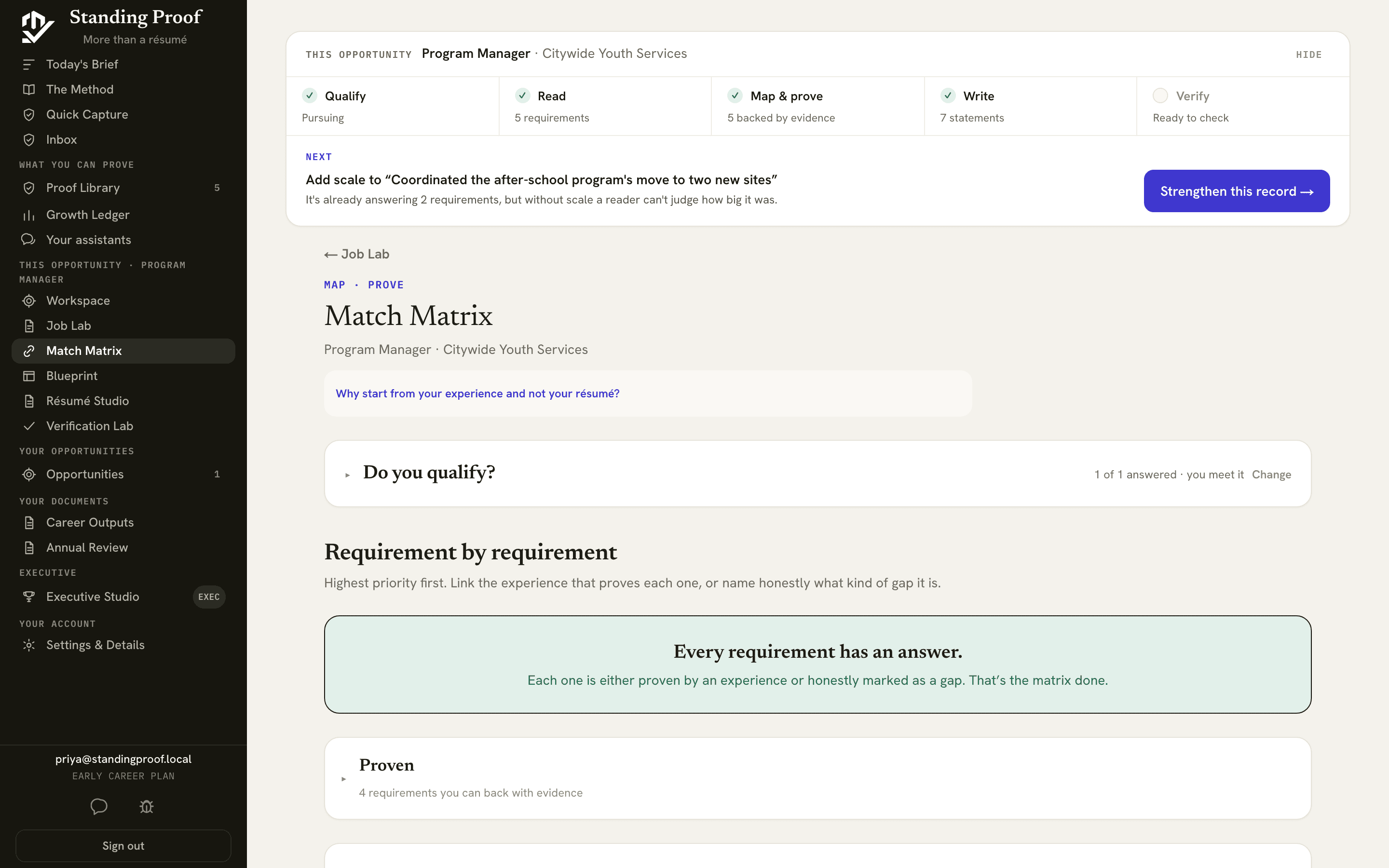
Every requirement, against what she already wrote down.
Five experiences in her library, captured when they happened. Four requirements are analyzed and all four have a record linked, each traced to something she can point at. The degree is a gate, kept separate: you either meet it or you don’t. Nothing is invented to fill a row.
On Early Career Decide, then write
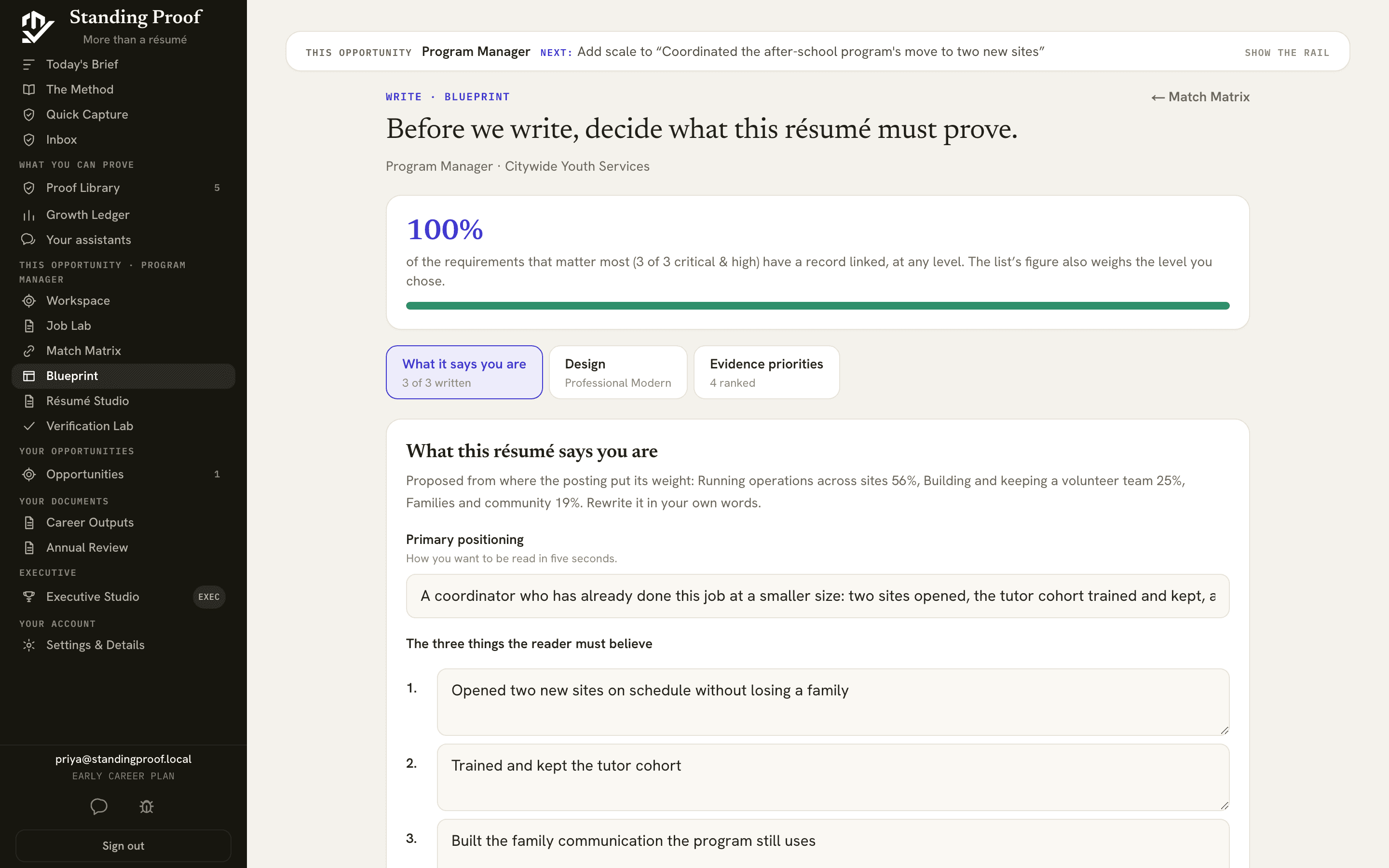
The posting puts 56% of its weight on running sites. So that leads.
This is the step almost everybody skips. The blueprint reads the weight the posting itself gave each thing, then asks for the three claims the document has to land and the order the evidence argues them in. The writing gets easy once this exists.
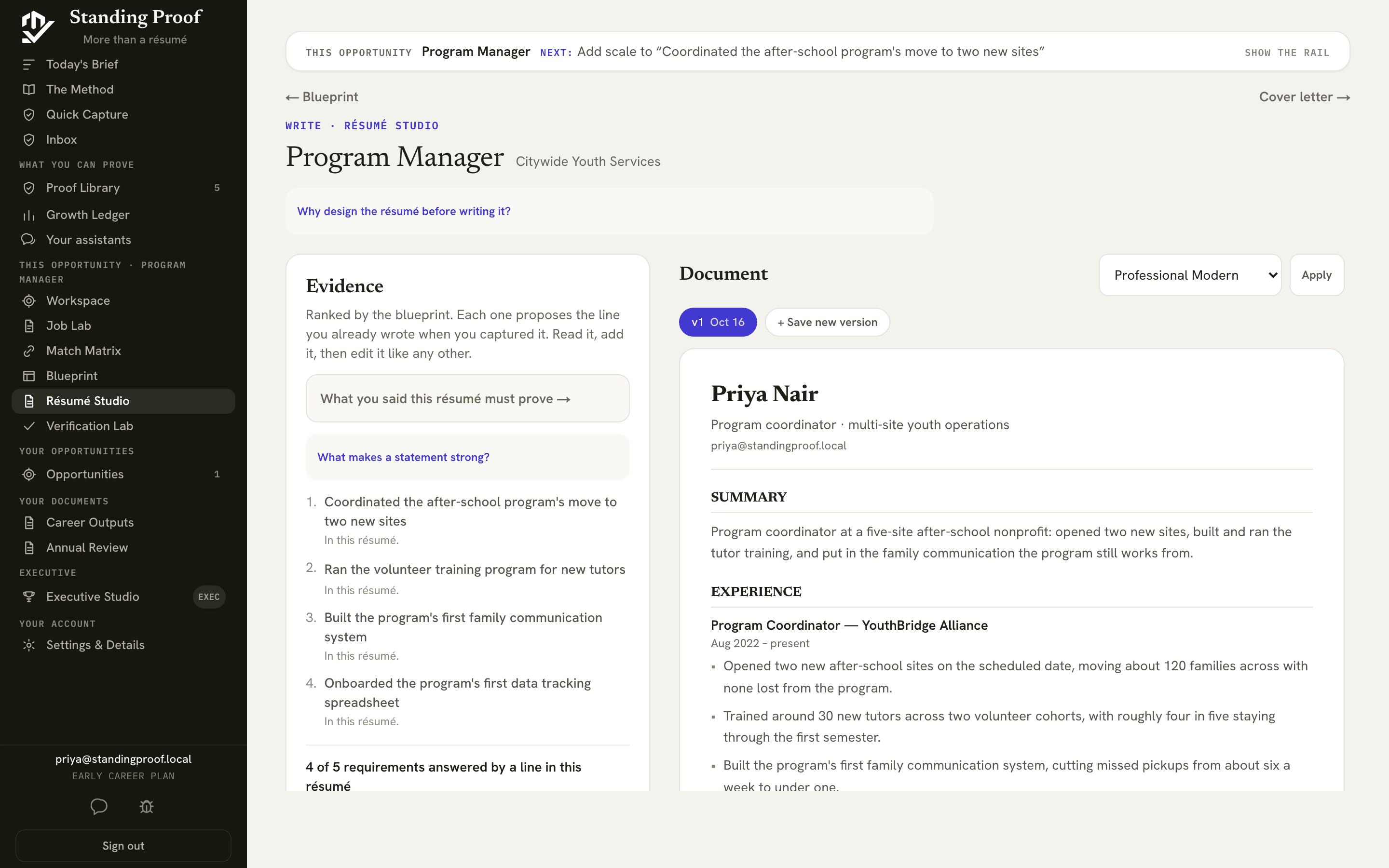
On Early Career The document compiles from the record
Every experience line names the record it came from.
She edits the words; she does not invent the facts. Each statement carries the record behind it and the requirement it answers, which is what makes the page defensible in a room: there is nothing on it she cannot talk about for ten minutes.
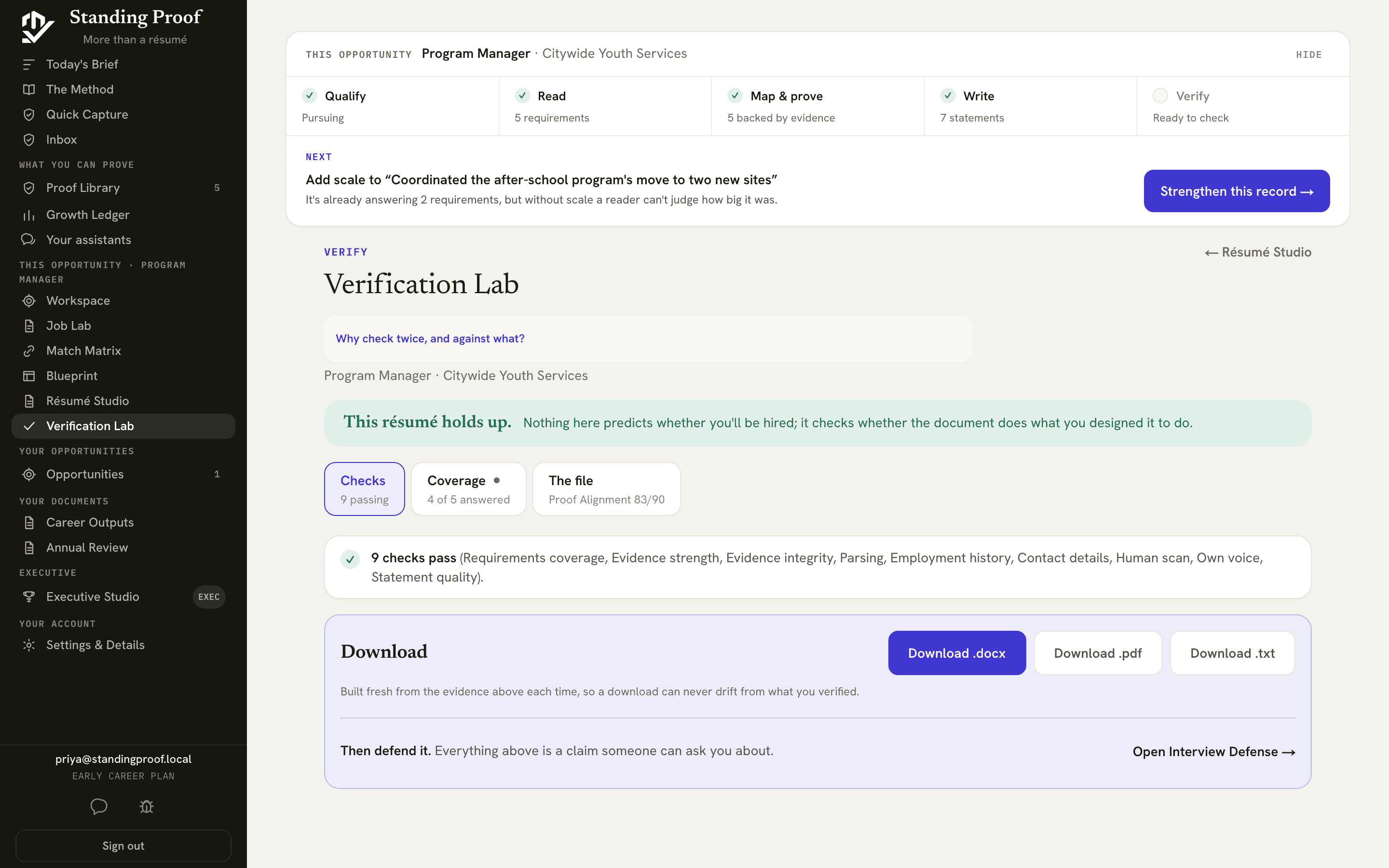
On Early Career Does it hold up?
Nine checks run before an employer runs their first one.
Coverage, evidence strength, whether every experience line traces to something real, whether the contact block can actually be replied to, and whether it reads like everyone else’s. “This résumé holds up.” Then the file, as .docx, .pdf, or the plain text an application form wants.
On Early Career What it was all for
Walking in already knowing what she can prove.
Not scrambling the night before. Not hoping nobody asks a second question. Every experience line on the page traces to something she documented, so the follow-up question is the easy part, and the next posting starts from the library rather than a blank page.

That is the whole loop, and the next posting starts from a library that is already five experiences deep. See what each plan includes →
More than a résumé
Your evidence doesn’t stop working when the résumé is finished
The records you keep for one application do the work of every professional moment after it.
Apply
Résumés and cover letters built from what you can prove, every experience line linked to the record behind it.
Interview
Walk in knowing what you can prove: the questions your résumé invites, rehearsed against your own records.
Advance
Your year and a self-evaluation drafted from it. Your role set against the next level, and the promotion case from the same evidence.
Establish
Case studies of your strongest work, ready to send. Professional, speaker and board bios from the evidence, not adjectives.
Grow
What the roles you aim at keep asking for, which of those your record cannot prove yet, and before each 1:1 with your manager, what you did since the last one.
One Proof Library. Every professional moment.
A timeline of your career, in the order the work happened, on every plan.
The documents are drafted on paid plans, and the pricing page says which plan opens which. Capturing what you did is on every plan.
Plans
Every plan is the whole method
Capturing, mapping, writing, verifying: included on every plan. What changes is the tools built on top of it, as your career moves.
Starter
$0
The method and the app that runs it: capture what you did, break a posting down, build and export the documents. What you capture becomes the Proof Library every later document is drawn from.
- Résumé Studio, with downloads
- Match Matrix and tracking
- Cover letters
- Career Timeline and Opportunity Compare
30 proof records
Start free →Early Career
$9/mo
For your first real roles: the interview stories, your annual review and a view of the next level.
Starter, plus
- All 12 résumé designs
- STAR story library and interview prep sheet
- Annual Review and Promotion readiness
- Career Transition Map, for a change of field
- A Librarian that reads your library for you
Professional
$29/mo
For a career in motion or a consulting practice: case studies, a LinkedIn profile, consulting profiles and a Coach.
Early Career, plus
- Case studies, as a file or a link
- LinkedIn profile and biography drafts
- A consulting profile and an evidence file per RFP
- A Coach that reads across your roles
- Files kept with your experiences, up to 2 GB
Executive
$59/mo
For leadership: an Advisor, the executive narratives, board readiness and your enterprise scope.
Professional, plus
- An Advisor that works a situation through with you
- Executive Narrative Studio, with 12 documents
- Board résumé and board biography
- Succession and promotion packets
- Board Readiness Review, across 6 committees
- Enterprise Scope & Evidence Map, 12 domains
- Files kept with your experiences, up to 10 GB
What sets it apart
- Compiled from your own words
- The Résumé Studio compiles the experiences you wrote, in your own words. It does not generate them.
- Checked before you download
- Nine checks, including that each experience line links to a record you wrote. No score to be fooled by.
- Fair on the way out
- Nothing converts on a date. Cancelling takes one screen. Moving down deletes nothing. The record is yours to take.
The whitepaper
Read the method before you commit to it
A 20-30 minute read, no signup required. Everything the product does is explained here first, in plain terms.

Where it lands
The room where someone asks a second question
Every line you write here already carries the scale, the stakes, and how you know. So when an interviewer points at one and says tell me about that, you are remembering out loud, not improvising.
Start with one thing you did.
Capture one experience today. That is the whole first step, it is free, and it is the part no generator can do for you.
Capture my first experience, freeRun a business? My Business is its own side of Standing Proof.