For reskilling programs
Your outcomes report is only as good as what your graduates can document
Standards bodies like CIRR ask member programs to report every outcome, every six months, backed by documentation and verified by a third party, with no selective reporting. That standard depends on a graduate who can actually produce the evidence when asked. This teaches them to keep it from day one.

The evidence problem sits before the reporting problem
By the time you are compiling an outcomes report, you are asking a graduate to reconstruct, months later, exactly what they built and what it did. It is the same reconstruction problem every résumé fights, except now it has to survive a third-party verifier rather than just a hiring manager.
Graduates who capture what they built as they build it (the problem, the decision, the measured result, and who can confirm it) arrive at outcomes-reporting season with an answer already written down, rather than a memory to reconstruct under a documentation requirement they did not know was coming.
What a cohort includes
A taught workshop
Reading a job posting as requirements, capturing project work as evidence with scale, stakes and a measured outcome attached, and writing only what survives a second question from an employer or a verifier.
A printed workbook each
The method works entirely on paper. Graduates write in it during the program and keep working from it after.
Individual accounts
Free accounts, claimed with a code, that continue on the free plan after the cohort ends. The record does not expire when the program does, which matters for a 180- or 360-day outcomes window.
Aggregate reporting
How many claimed a seat, how many built a working evidence base with real requirement analysis and traced documents behind it, how many are still maintaining that record at 30, 60 and 90 days, and how many recorded an accepted offer against an application they tracked here.
What you will not receive, and why that is the point
You receive counts. You do not receive a graduate’s record, their documents, or their name against any of it. Graduates writing candidly about what they have not yet proven will not do it if they believe the program grading their cohort is reading it.
Graduates are told this in the product itself, at the moment they claim their seat, rather than being left to wonder.
Being straight about what this is
We have not run a bootcamp cohort before. The method, the platform and the reporting are built and in use; this packaging of them for a reskilling program is new, and you would be among the first. If that matters to you, it should, and we would rather you knew now.
We are not CIRR, and this is not CIRR membership. CIRR is named here because its standard is real, checkable, and asks for exactly what this product produces, not because we are affiliated with it or certified by it. Verify your own reporting obligations independently.
We do not promise a placement rate. We will not tell you a percentage of your graduates will be placed, because we could not support it. What we will tell you is exactly how many built a documented record, in numbers you can check.
Read the method before you commit
The method as worksheets, in full and free. Read it before you decide where this sits in your schedule.
The Evidence Starter Kit
The worksheet version of the method, for someone with no account.
Open the PDF (11 pages) →Free to print, copy and use, including in your own classes, with or without the software.
The Participant Workbook
The six-session program itself, printed, one per participant. Part of every program we run rather than a download: you see the full workbook on the fit call, and your cohort writes in theirs.
© Enterprise Professional Systems LLC. Provided for use in Standing Proof programs.
What a graduate can hand an interviewer
The stories behind the projects, in the shape an interviewer asks for (situation, task, action, result), drawn from what the graduate actually recorded while building.
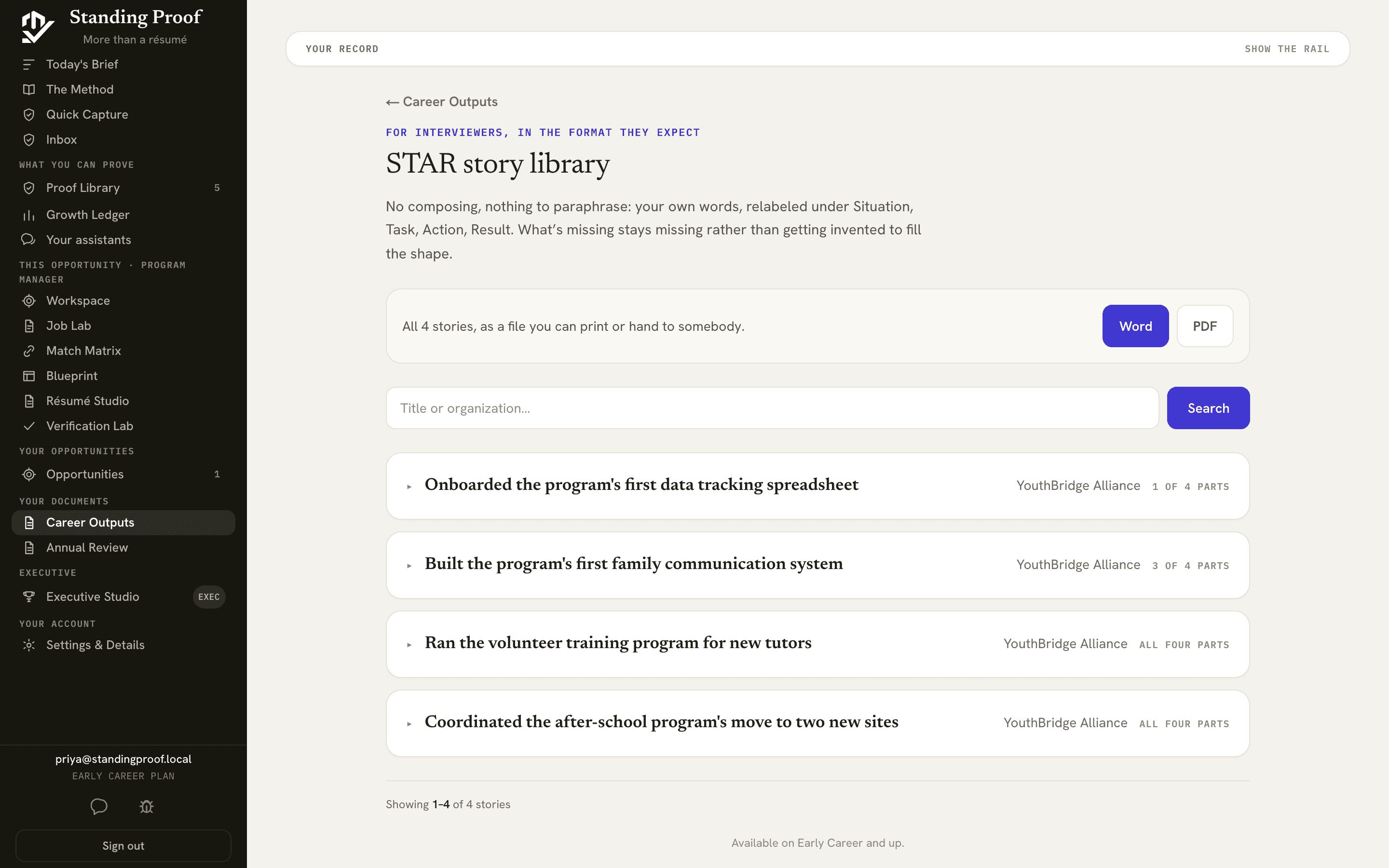
On Early Career
These are the product itself, running on an example account. The names, numbers and history in them are invented; none of it is a real person’s record.
What a program can buy
Quoted for your group, and lower per person as the group grows. Each of these is priced in the conversation: the scope depends on how many people, over what period, and what you already report and to whom. That is why there is no figure beside them, not because it is a secret; ask and you will get a straight answer.
Four-hour workshop, up to 20 participants
A single cohort, one session.
What is included ↓
Four-hour workshop, up to 20 participants
How it’s done
- Four-hour facilitated workshop
- Participant workbooks
Workshop plus participant licenses
A cohort that keeps working after the session.
What is included ↓
Workshop plus participant licenses
How it’s done
- Everything in the four-hour workshop
- Participant platform access
- Aggregate cohort reporting
Career Evidence Lab, 10 participants
Small, high-touch cohorts.
What is included ↓
Career Evidence Lab, 10 participants
How it’s done
- Multi-session facilitated lab
- Per-participant evidence development
- Platform access for the cohort
- Cohort reporting: participation and demonstrated skill
Career Evidence Lab, 20 participants
Full cohorts.
What is included ↓
Career Evidence Lab, 20 participants
How it’s done
- Multi-session facilitated lab
- Per-participant evidence development
- Platform access for the cohort
- Cohort reporting: participation and demonstrated skill
Workforce practitioner training, up to 15 staff
Training an organization's own career staff.
What is included ↓
Workforce practitioner training, up to 15 staff
How it’s done
- Practitioner curriculum
- Staff platform access
Employer skills-first hiring workshop
Employers rather than job seekers.
What is included ↓
Employer skills-first hiring workshop
How it’s done
- Facilitated employer workshop
Scoped together rather than from a list: train-the-trainer and annual curriculum license; custom workforce cohort or program; professional résumé package, per participant.
Start with the twenty-minute conversation. It is where the number is appropriate, and where we will say if none of these is the right instrument for what you are trying to reach.
Tell us the situation
What you already report, on what schedule, and to which standard or accreditor. A real person answers.
Book a conversationPrefer email? hello@standingproof.com
Running this from a college or university career office instead? See the career services page.