For career services
A cohort that raises your own knowledge rate
NACE asks for a First-Destination Survey with a defensible knowledge rate, minimum 65%. Every graduate you cannot reach after they leave is a mark against that number. This is a career-readiness cohort built on the same evidence discipline, run for students who are still on campus and easy to reach.

The gap between the résumé workshop and the survey
A résumé workshop produces attendance. NACE’s standard asks for something else entirely: a classified, published outcome for each graduate, with the collection method disclosed, six months after they leave. The workshop and the survey are measuring different things, which is why a well-attended workshop and a poor knowledge rate can both be true at once.
The reason the gap is hard to close from the survey side is timing: by the time you are trying to reach a graduate for their first-destination outcome, they are gone, and so is your leverage to get a real answer. The reason it is easy to close from this side is that students are still on campus, still checking their student email, and still willing to fill in a form.
What a cohort includes
A taught workshop
Reading a posting as requirements, recovering evidence from coursework, internships and campus work most students have never written down as accomplishments, and writing only what survives a second question.
A printed workbook each
The method works entirely on paper. Students write in it during the session and keep working from it afterward.
Individual accounts
Free accounts, claimed with a code, that continue on the free plan after the term ends. The record does not expire when the semester does.
Aggregate reporting
How many claimed a seat, how many built a working evidence base, how many are still actively maintaining it at 30, 60 and 90 days, what representation gaps the cohort surfaced, and how many closed the loop on an application they tracked here with a final result: an offer, a rejection, an accepted role.
What you will not receive, and why that is the point
You receive counts. You do not receive a student’s record, their documents, or their name against any of it. A student writing candidly about what they have not yet proven will not do it if they believe the office administering their financial aid is reading it.
Students are told this in the product itself, at the moment they claim their seat, rather than being left to wonder.
Being straight about what this is
The method and the platform are in use; the campus packaging is new. People are building records with this today and the reporting already runs. What is new is delivering it as a career-services cohort, so the first offices to run one get pilot terms and a say in how the reporting is shaped. You hear that from us rather than discovering it later.
You get numbers you can check. Exactly how many students engaged, how many built records, and how many can be reached again. We will not quote you a knowledge-rate lift, because nobody can predict your survey, and a figure we could not support is the first thing your assessment office would take apart.
There is no job board. This is not a placement service. It makes students able to describe and prove their work; where they take that is theirs.
The evidence
Why this is worth a place in your programming
A short paper drawing together the research on what a career transition actually costs, across four areas that rarely appear in the same document: earnings, health, professional networks, and children in the household. It is the case for teaching capture rather than composition, and for measuring outcomes rather than documents produced.
Every figure is sourced and every scope limit is stated, including the two places where we say plainly what a study does not show. Free to print and hand to a committee.
More Than a Résumé (PDF, 8 pages)Read the method before you commit
The worksheet version of the method, in full and free. Look at what your students would actually do before you put it in front of them.
The Evidence Starter Kit
The worksheet version of the method, for someone with no account.
Open the PDF (11 pages) →Free to print, copy and use, including in your own classes, with or without the software.
The Participant Workbook
The six-session program itself, printed, one per participant. Part of every program we run rather than a download: you see the full workbook on the fit call, and your cohort writes in theirs.
© Enterprise Professional Systems LLC. Provided for use in Standing Proof programs.
What a student is actually building
Every student leaves with this: their own evidence record, on a free account they keep after they graduate and after your funding cycle ends.
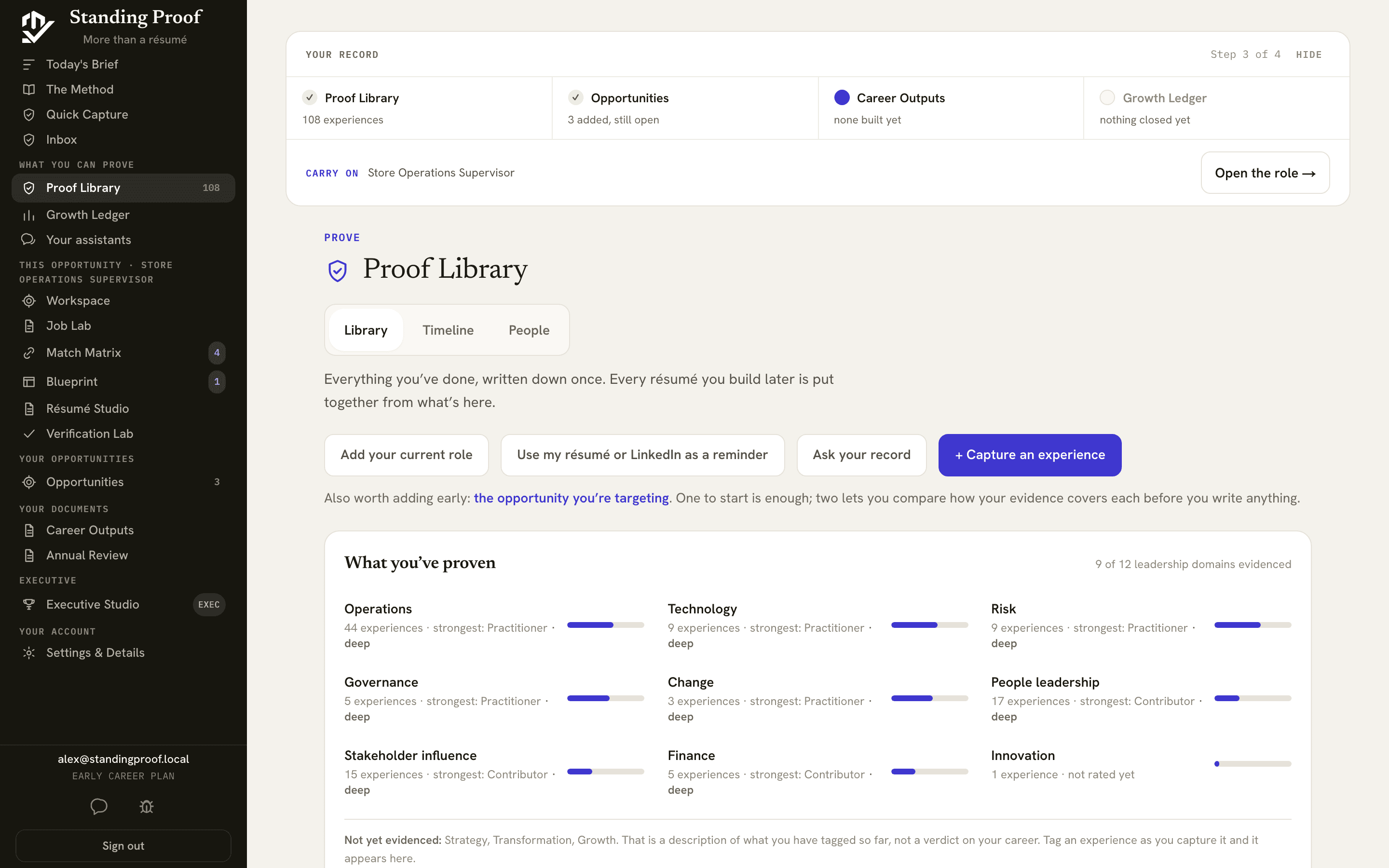
On Early Career
These are the product itself, running on an example account. The names, numbers and history in them are invented; none of it is a real person’s record.
What a program can buy
Quoted for your group, and lower per person as the group grows. Each of these is priced in the conversation: the scope depends on how many people, over what period, and what you already report and to whom. That is why there is no figure beside them, not because it is a secret; ask and you will get a straight answer.
Four-hour workshop, up to 20 participants
A single cohort, one session.
What is included ↓
Four-hour workshop, up to 20 participants
How it’s done
- Four-hour facilitated workshop
- Participant workbooks
Workshop plus participant licenses
A cohort that keeps working after the session.
What is included ↓
Workshop plus participant licenses
How it’s done
- Everything in the four-hour workshop
- Participant platform access
- Aggregate cohort reporting
Career Evidence Lab, 10 participants
Small, high-touch cohorts.
What is included ↓
Career Evidence Lab, 10 participants
How it’s done
- Multi-session facilitated lab
- Per-participant evidence development
- Platform access for the cohort
- Cohort reporting: participation and demonstrated skill
Career Evidence Lab, 20 participants
Full cohorts.
What is included ↓
Career Evidence Lab, 20 participants
How it’s done
- Multi-session facilitated lab
- Per-participant evidence development
- Platform access for the cohort
- Cohort reporting: participation and demonstrated skill
Workforce practitioner training, up to 15 staff
Training an organization's own career staff.
What is included ↓
Workforce practitioner training, up to 15 staff
How it’s done
- Practitioner curriculum
- Staff platform access
Employer skills-first hiring workshop
Employers rather than job seekers.
What is included ↓
Employer skills-first hiring workshop
How it’s done
- Facilitated employer workshop
Scoped together rather than from a list: train-the-trainer and annual curriculum license; custom workforce cohort or program; professional résumé package, per participant.
Start with the twenty-minute conversation. It is where the number is appropriate, and where we will say if none of these is the right instrument for what you are trying to reach.
Tell us the situation
How many students, which class or program, and what your survey already shows about the gap. A real person answers.
Book a conversationPrefer email? hello@standingproof.com
Running this for a workforce or WIOA-funded program instead? See the workforce pilot.