For employers
Outplacement that leaves people with something they keep
Most outplacement gives someone a rewritten résumé and a login that stops working in ninety days. This teaches a method they keep using, and the evidence record they build stays theirs permanently, on a free plan, after your program ends.

The problem with a rewritten résumé
Someone leaving your organization is carrying years of work they cannot currently describe. The numbers are in dashboards they have lost access to and emails they no longer have. A writer produces one good document from what they can remember on the day, and six months later, in a different search, they are back to remembering.
The useful thing to do in the weeks after a separation is not to polish one document. It is to recover the evidence while it is still reachable, and to leave with a record that answers the next posting as well as this one.
What a program includes
A taught workshop
Four hours, live, delivered by the person who wrote the method. Reading a posting as requirements, recovering evidence from their own history, and writing only what survives a second question.
A printed workbook each
The method works entirely on paper. Participants write in it during the session and keep working from it afterwards.
Ninety days of full access
Individual accounts, claimed with a code. No card, and nothing for the participant to pay. People who leave on different dates each get their own ninety days from the day they start.
A record they keep
When the window closes the account continues on the free plan with everything in it. Nothing is deleted because your program ended.
Aggregate reporting
How many claimed a seat, how many built a working evidence base, how many were still maintaining it at thirty, sixty and ninety days, plus the count of evidence people recovered that they had never written down.
What you will not receive, and why that is the point
You receive counts. You do not receive participants’ records, their documents, their readiness views, or their names against any of it. If you ask us which individuals have engaged, we will decline and write you a reminder instead, with your access code and link, ready for your program to send to everyone.
This is not us being difficult with a paying customer. Your former employees are being asked to write down, candidly, what they did and what they cannot yet prove. They will not do that if they think it is being read by the organization that just let them go, and a program they do not engage with honestly is one you paid for and did not get.
Participants are told this in the product itself, at the moment they enter your code, rather than being left to wonder.
Being straight about what this is
We have not run an employer outplacement program before. The method, the platform and the reporting are built and in use; this particular packaging of them is new, and you would be among the first. If that is a problem, it should be, and we would rather you knew now.
We do not promise placements. We will not tell you a percentage of your people will land in ninety days, because we could not support it. What we will tell you is exactly what participants did with the program, in numbers you can check.
There is no job board. We are not a placement service. We make people able to describe and prove their work; where they take that is theirs.
Read the method before you commit
The method as worksheets, in full and free: what a candidate works through, before you decide to hand it to one.
The Evidence Starter Kit
The worksheet version of the method, for someone with no account.
Open the PDF (11 pages) →Free to print, copy and use, including in your own classes, with or without the software.
The Participant Workbook
The six-session program itself, printed, one per participant. Part of every program we run rather than a download: you see the full workbook on the fit call, and your cohort writes in theirs.
© Enterprise Professional Systems LLC. Provided for use in Standing Proof programs.
What a departing employee leaves with
More than a résumé for the next application: documents built from one evidence record, for the rooms a résumé does not reach.
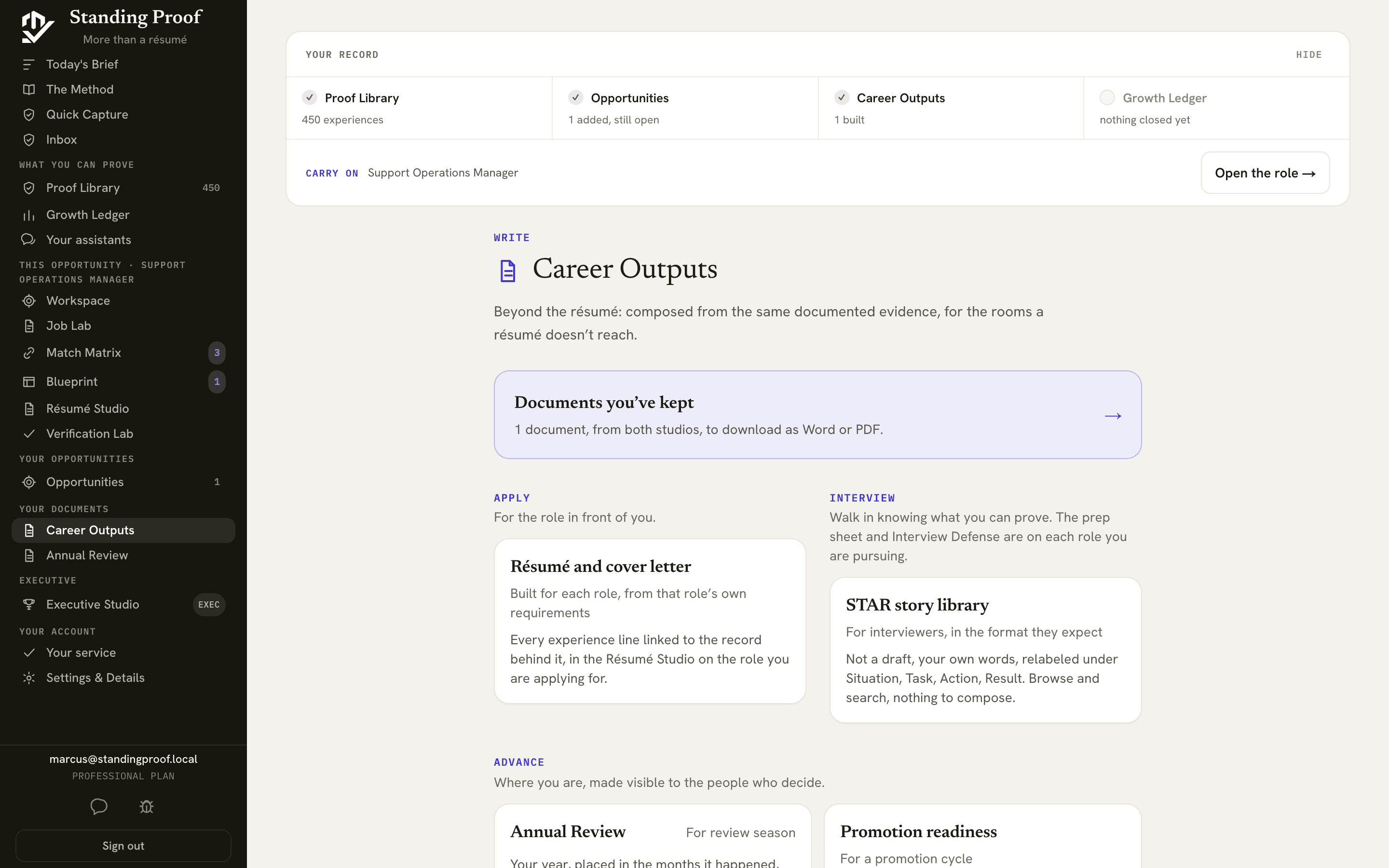
On Professional
These are the product itself, running on an example account. The names, numbers and history in them are invented; none of it is a real person’s record.
What a program can buy
Quoted for your group, and lower per person as the group grows. Each of these is priced in the conversation: the scope depends on how many people, over what period, and what you already report and to whom. That is why there is no figure beside them, not because it is a secret; ask and you will get a straight answer.
Four-hour workshop, up to 20 participants
A single cohort, one session.
What is included ↓
Four-hour workshop, up to 20 participants
How it’s done
- Four-hour facilitated workshop
- Participant workbooks
Workshop plus participant licenses
A cohort that keeps working after the session.
What is included ↓
Workshop plus participant licenses
How it’s done
- Everything in the four-hour workshop
- Participant platform access
- Aggregate cohort reporting
Career Evidence Lab, 10 participants
Small, high-touch cohorts.
What is included ↓
Career Evidence Lab, 10 participants
How it’s done
- Multi-session facilitated lab
- Per-participant evidence development
- Platform access for the cohort
- Cohort reporting: participation and demonstrated skill
Career Evidence Lab, 20 participants
Full cohorts.
What is included ↓
Career Evidence Lab, 20 participants
How it’s done
- Multi-session facilitated lab
- Per-participant evidence development
- Platform access for the cohort
- Cohort reporting: participation and demonstrated skill
Employer skills-first hiring workshop
Employers rather than job seekers.
What is included ↓
Employer skills-first hiring workshop
How it’s done
- Facilitated employer workshop
Scoped together rather than from a list: custom workforce cohort or program; professional résumé package, per participant.
Start with the twenty-minute conversation. It is where the number is appropriate, and where we will say if none of these is the right instrument for what you are trying to reach.
Tell us the situation
How many people, over what period, and whether senior departures need something more individual. Quoted for your group, and lower per person as the group grows. A real person answers.
Book a conversationPrefer email? hello@standingproof.com
For a senior departure, the Standing Proof Executive Engagement is the individual version, and an employer can buy it directly.
Supporting people you are keeping rather than losing? The same method runs for internal cohorts.